How to Plan a Construction Project — A Complete Guide by Vertex Estimation
A construction project is similar to laying the groundwork before the walls. In the absence of a proper plan, projects experience delays, overruns, and stresses. Money, time, and quality can be saved using the proper process. Regardless of the size of your residential, commercial, or industrial construction project, Vertex Estimation will take you through the steps of planning your construction project with practical steps.
Why planning matters in construction
And a project is a planless journey–you may arrive somewhere, but not where you wanted to be. Planning ensures:
- There is control of costs through precise budgeting.
- Projects do not miss out on timelines or run behind.
- Allocation of resources is efficient and less wasteful.
- Uncertainties are detected at an early stage, and no surprises are encountered.
- Quality is met, and clients remain satisfied.
Step 1: Define project goals and scope
Every successful project starts with clarity. What do you want to build? What’s the purpose? Defining scope early avoids “scope creep,” where small changes grow into big, costly shifts. At this stage, list:
- Project size and type
- Key features or requirements
- Desired quality standards
- Deadlines and milestones
Step 2: Develop a realistic budget
It is in budgeting that estimation becomes critical. An accurate estimation includes materials, labor, equipment, permits, and contingency funds. At Vertex Estimation, some development of cost breakdowns with transparency, away from owners and contractors, where the money is.
Using residential construction as an example, residential construction estimating does not subject the homeowner to any unexpected costs, such as repairs to the structure or utility bills. Relative to that, commercial construction estimation takes into account larger crews, safety, and the tenant schedule. And as industrial construction plans ahead, specialized equipment and long lead times become critical.
Step 3: Build a project timeline
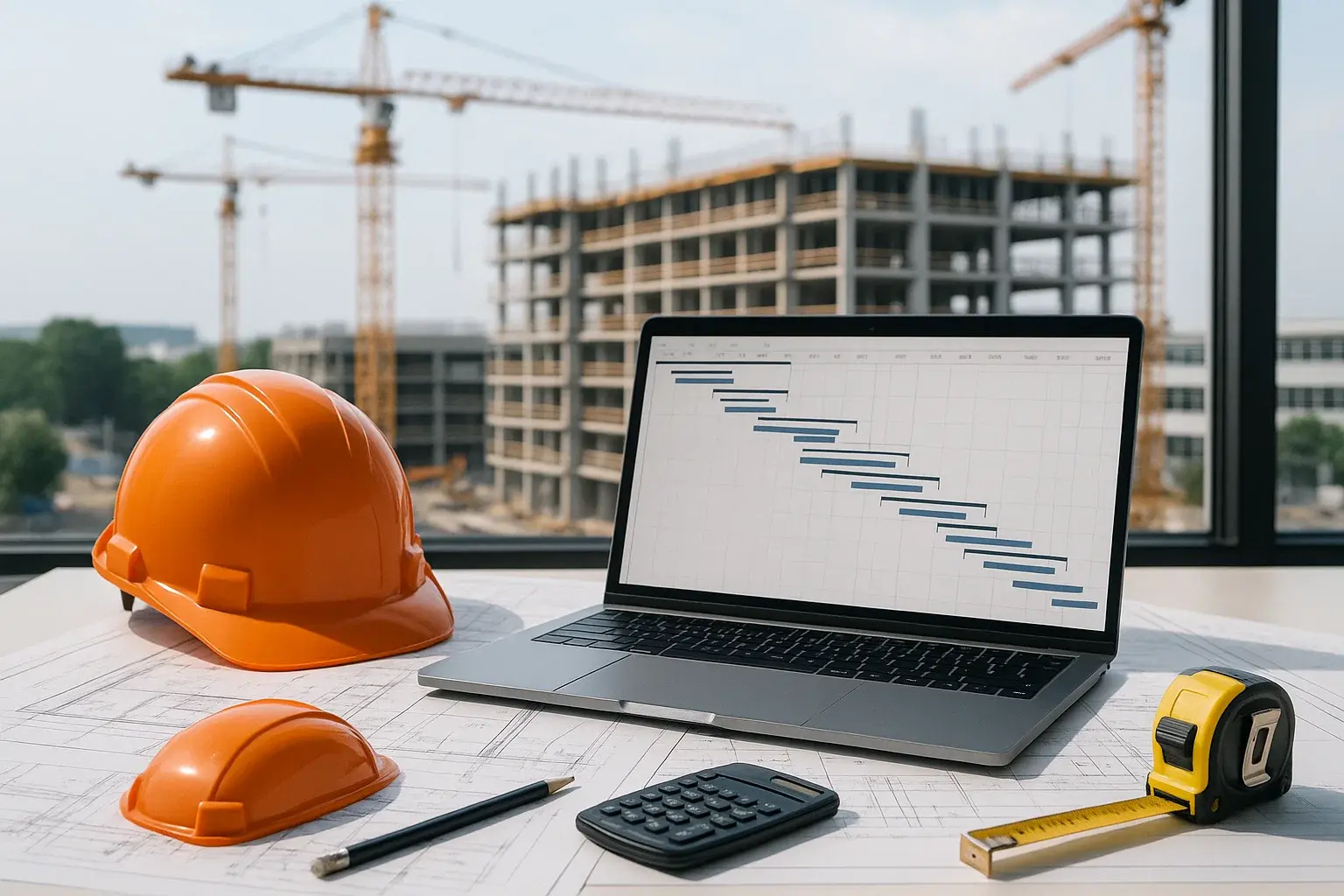
Money is as nothing when compared with Time. A construction schedule contains some start dates, some task durations, some dependencies, and some completion deadlines. The division of tasks into steps, such as site preparation, foundation, building, interior, and finishing, also assists in monitoring project progress. This timeline is backed by a solid estimate that keeps crews and suppliers on schedule.
Step 4: Assess risks and plan for contingencies
There is no construction project that cannot be risky. Progress can be affected by weather, market prices, labour shortages, or delays in permits. Good planning involves the early identification of risks and the addition of buffers on Time and money. Vertex Estimation leverages the best risk-estimation techniques to enable clients to be ready in the face of the unknown.
Step 5: Assemble the right team
Nothing works without talented individuals, even the best plan. Select seasoned contractors, dependable traders, and skilled labor. When designers, engineers, and contractors have good lines of communication, it saves Time and reduces misunderstandings. An estimate that is properly prepared also generates trust in having clear expectations.
Step 6: Secure permits and legal approvals
All projects should meet local codes, rules of safety, and law. Zoning permit, electrical, plumbing, and occupancy permits must be included in the schedule and budget. It can be expensive to skip or delay this step.
Step 7: Organize resources and logistics
Planning refers to information about when and how the resources will come in. Premature deliveries generate storage expenses, and late deliveries generate a late time of arrival. Accurate estimations and coordination with suppliers enable Vertex Estimation to balance the logistics so that the workflow can flow smoothly.
Step 8: Monitor and adjust during construction
Even the most effective plan should be flexible. Periodic progress assessments are used to determine the actual expenditure and Time against the estimate. Teams are able to readjust when problems manifest themselves. This is because the decision-making remains fact-based rather than reactive when using the estimate as a reference.
Tools and techniques for better project planning
Work breakdown structures (WBS): break down projects into manageable tasks.
Critical path method (CPM): list the activities used to determine the overall completion.
Gantt charts: visualise dependencies and timelines.
Predicate software: automate takeoffs and cost submissions.
Vertex Estimation incorporates all these tools together with the use of the experienced person and provides valuable and workable plans.
Common mistakes in project planning
- Skipping detailed cost estimates and relying on rough numbers.
- Ignoring contingency funds.
- Not involving subcontractors early in the process.
- Failing to update the plan when conditions change.
Avoiding these mistakes saves time, money, and frustration.
Why Vertex Estimation makes planning easier
Planning a project is challenging, but you don’t have to do it alone. With expertise in residential, commercial, and industrial estimating, Vertex Estimation provides:
- Transparent budgets with detailed line items.
- Realistic schedules based on experience and data.
- Risk assessments that prevent surprises.
- Guidance tailored to your project type.
- Transparent budgets with detailed line items.
Final thoughts
The difference between failure and success lies in the area of construction planning. A well-defined set of goals, a decent budget, a realistic schedule, and an active approach to risk management help you achieve your vision of the project and complete it as planned. With correct estimating, all of these steps get connected, and you are confident at each stage.
Vertex Estimation assists clients in developing smarter by transforming intricate projects into focused plans that are manageable. It could be a house, a business location, or an industrial plant; a proper plan is the best place to begin.